
.png)
One of our favourite things about the Inkwell community is that it’s full of people who love sharing what they’ve learned. Whether it’s a clever solving technique, a helpful tip, or a completely new way of looking at a puzzle, our players are always finding ways to help each other get even more enjoyment out of puzzling.
This week, I’m excited to hand the blog over to one of our wonderful Inkwell Insiders, Dave Hayden. Dave has generously put together this Lazy River guide, and I think you’re going to love it. It has an intimidating start, but it’s easy to follow, and packed with insights that will help you become a more confident Lazy River solver.
From Dave:
One of the classic proof problems in mathematics asks you to consider a checkerboard with a single square removed. The challenge is to prove that it’s impossible to create a continuous loop that moves only between edge-adjacent squares (no diagonal moves) while visiting every remaining square exactly once. The key observation is that the path always alternates between white squares and black squares, which means the loop must touch the same number of white and black squares. But since there’s an unequal number of white and black squares on the board, the loop can’t possibly touch them all.
A related lemma: if there is such a closed loop covering all squares then any region with an equal number of white and black squares must have the same number of black and white squares where the path enters the region. Here’s a simple proof (which you should feel free to skip): There will be one or more sections of the loop entering and exiting the region. Each one will either enter on a white square and exit on a black square or vice versa, enter and exit on black squares, or enter and exit on white squares. We can ignore the first category because if we remove those squares we still have an equal number of white and black squares. The remaining paths that enter and exit on the same color have one more of that color on their path than the other. Since these unbalanced paths cover an equal number of black and white squares, there must be an equal number of them—which means that in total they have an equal number of black and white exits, as does the first category of balanced paths we ignored.
Great, but how do we use this in practice? Here’s the July 19, 2026 Lazy River puzzle with the corners already marked (which should be the first thing you do, IMO):
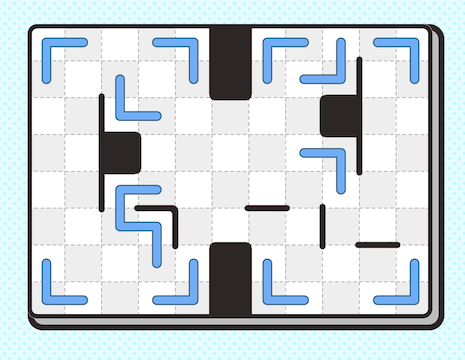
Let’s zoom in to the 4x4 corner in the top right. Here’s a pattern we see often, a corner with one edge blocked:
.png)
You probably already know that the path has to exit out the bottom left white square–otherwise it would form a loop with the corner path. But using our lemma all we have to do is recognize that it’s the only white exit out of the 4x4 region (which, of course, has two white squares and two shaded).
.png)
But we can keep going! Now we have a 2x3 area with three white and three shaded squares and only one exit out of a white square, so we’ll go ahead and mark that, and then continue growing the region in the same fashion: we expand the region with an equal number of white and shaded squares, and if the white square only has one exit we can mark it and repeat. Here we’ve reached the end of this chain because the white square has two possible exits:
.png)
A 3x3 square with a corner cut off always has four white and four shaded squares. In this case we know the path has to exit out the top left square:
.png)
We add on the 2x2 corner and here we are again, with only one white exit:
.png)
Following this to completion (and this is just doing the simple add-two-more method, no deep thought required) here’s where we wind up:
.png)
And then it’s a straight shot to the end! We continue extending all the sections that only have one way to go and filling in the new corners that get made, and it all falls together easily.
.png)
.png)
.png)
.png)
.png)
.png)
.png)