
.png)
Advanced solving is all about subtle pressure. At this level, progress often comes from understanding what can’t happen rather than what must happen immediately. You’ll use long-range constraints, orphan behavior, and multi-step consequences to force solutions, sometimes several moves before anything visibly changes. Slow, thoughtful, and deeply satisfying.
Topology
Take a look at this example:
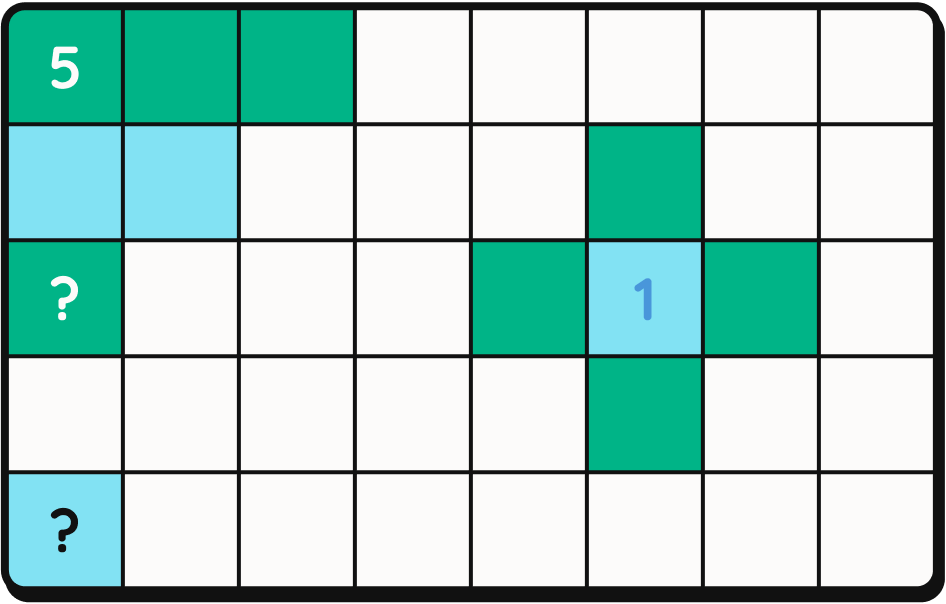
You should notice two things.
- The orphan green cells must connect to the green [?]
- The orphan blue cells must connect to the blue [?]
We don’t know the exact paths these Fields take to connect, but we can still make some conclusions about paths based on their starting and ending points. For example, what happens if we try to connect the blue Field using a path that goes though the center of the grid?
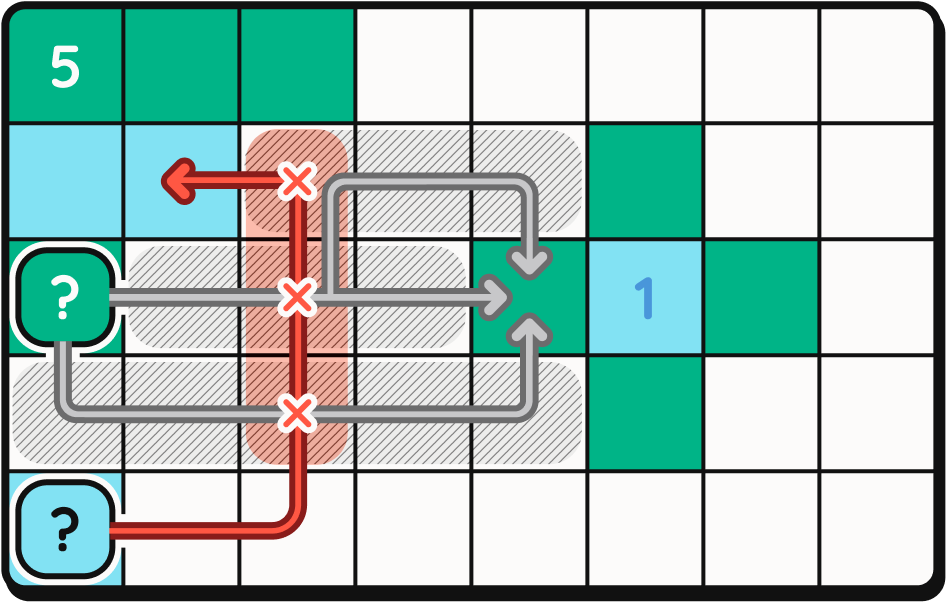
The green region is completely cut off! Regardless of the specifics of the blue path, the green orphan cells will never be able to connect to the green [?]. The blue path must go completely around the green orphan cells in order to allow them to reach the green [?].
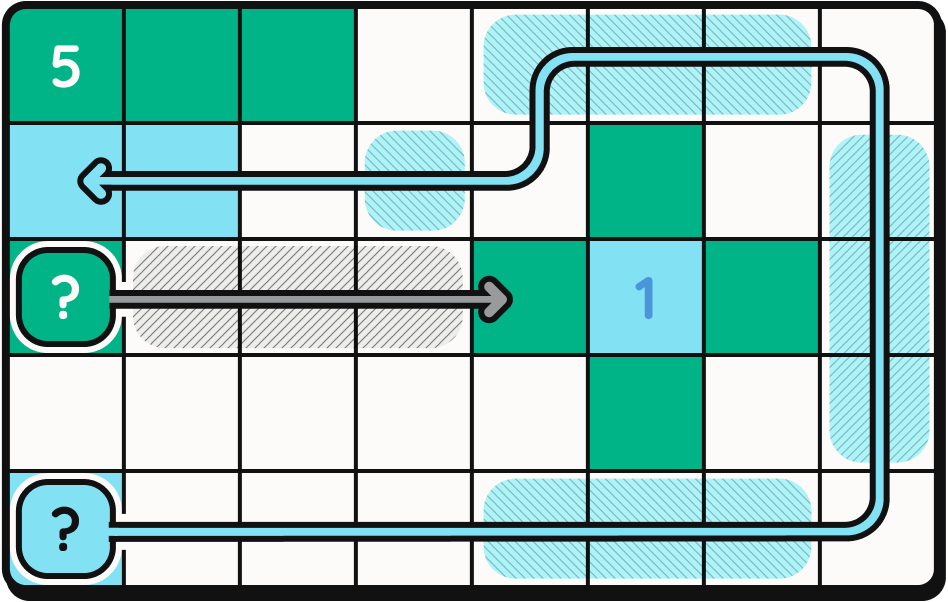
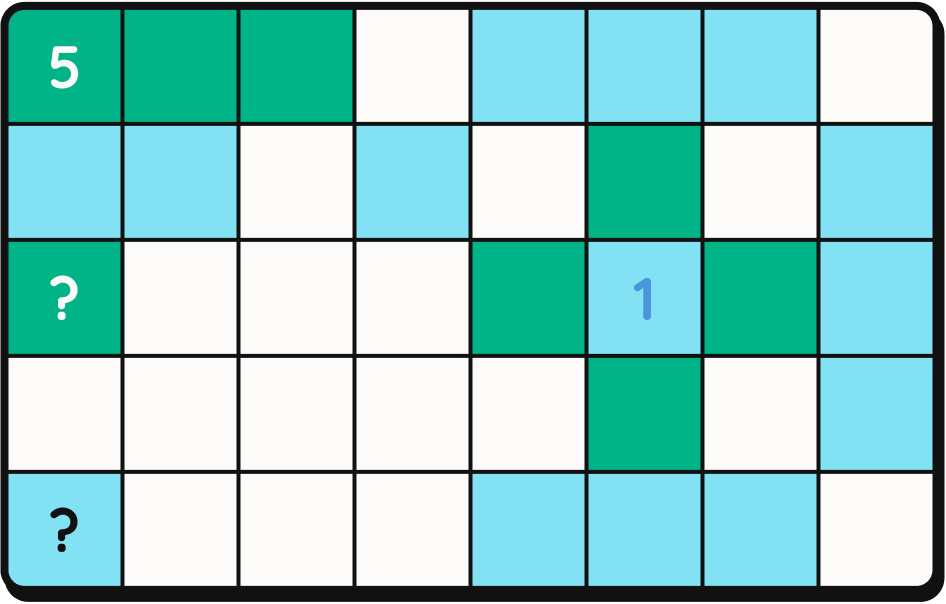
There is a variety of different topology arguments to spot, but the general idea is considering how connections between Fields will affect each other. Look for situations where you know groups of Fields must connect, but you don’t know exactly what paths must be taken.
Gap Budget
When a Field is trapped in an area that is only a bit larger than its target size, a specific amount of those cells will be the opposite color. This can lead to helpful deductions!
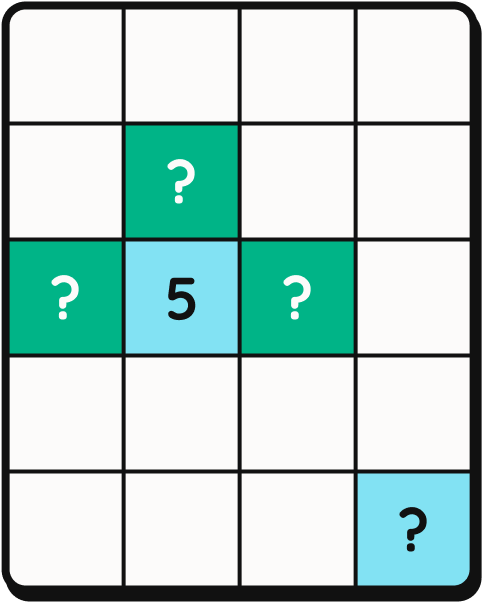
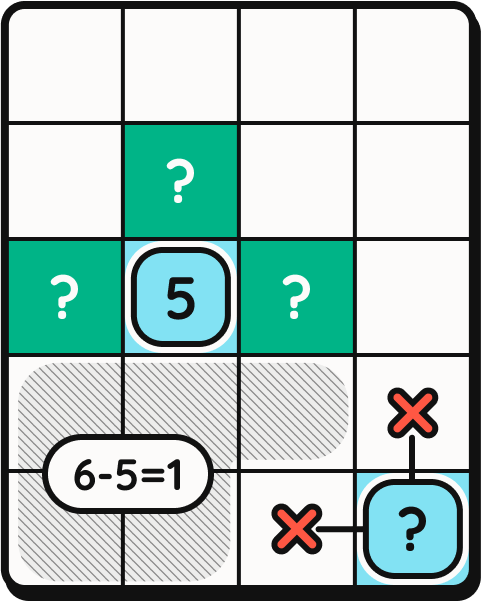
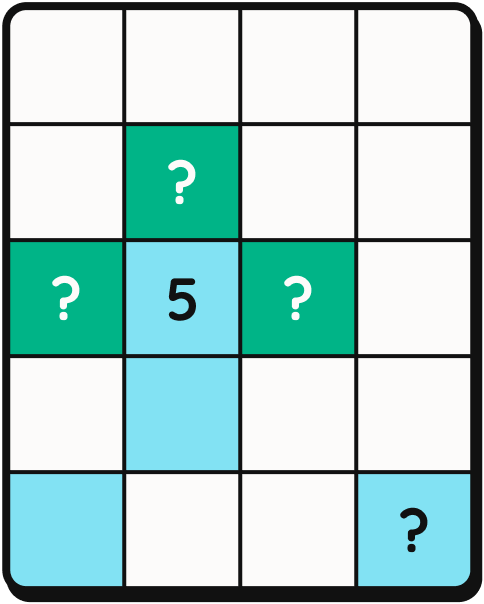
The blue 5 is pretty constrained. It can only reach 6 possible cells before being fully trapped with nowhere else to go. We know that in the end, exactly 5 of those cells will be blue, and — importantly — exactly one of the cells will be green. I like to say that the “Budget” is 1. We have to precisely spend the Budget on green cells within this area, and the cells we don’t budget for will be part of the 5.
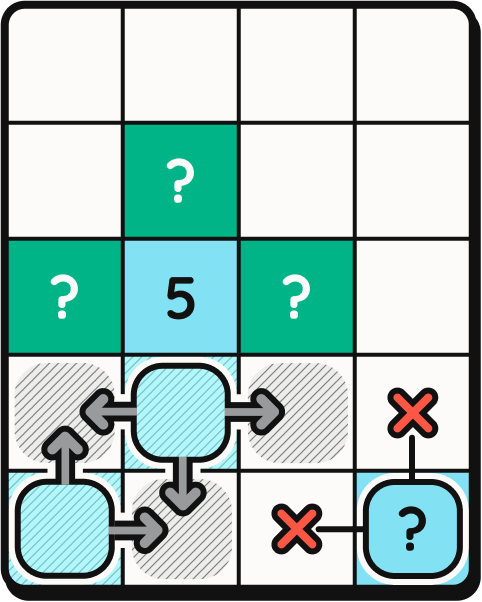
Knowing that we have a Budget of 1 within this area is very useful. For example, neither of the indicated cells could possibly be green. If they were green, they would become orphan cells that can’t expand in any direction without making a second green cell within the area, therefore exceeding the Budget.
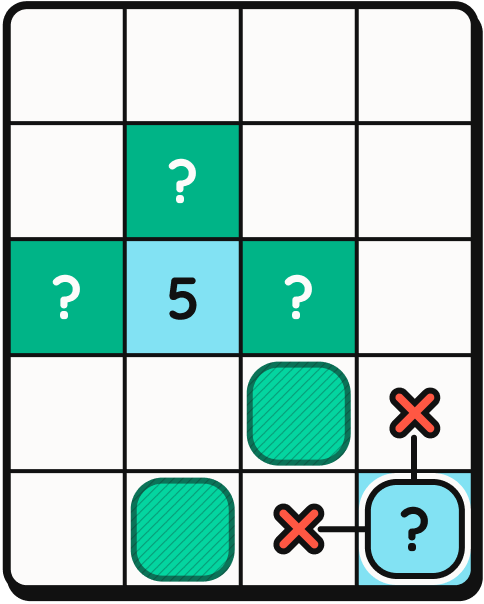
A different piece of logic to spot here is that at least one of these indicated cells must be part of the 5; They can’t both be green without violating the Budget. It doesn’t matter which cell is part of the 5, because in either case, the 5 will nearly be touching the blue [?] and must be separated by a green cell.
This strategy can be extended to cases where the gap budget is a bit larger than 1, but it is usually not as powerful due to many more possibilities existing.
Running Trials
Monday-Friday Fields puzzles usually don’t require thinking more than a couple steps ahead, but weekend puzzles may require the use of trials when you’re not sure where to look next. Here’s a step-by-step guide to run trials effectively!
- Identify the most restricting cell you can color. Look for a cell you can color that puts Fields into a tight spot, cuts off important paths, or generally forces you to make additional moves in response to the cell you just colored.
- Color the cell you identified. This is just a guess, so you might have to revert it later. Don’t make any more guesses from this point onward!
- Follow the logical path of the cell you’ve colored. You’ll encounter one of a few scenarios here:
- You reach a point where can’t deduce anything elseThis trial was a bust! Time to revert the puzzle back to before you started the trial.
- You make a lot of progress with no sign of slowing downIf you’ve been able to make 5-10 additional steps without running into a contradiction: you may have happened to correctly guess the color of the cell, OR, you may have started a trial that makes the puzzle impossible, but you’ll only find out after many many moves. Either way, you can’t really deduce anything about your trial and it’s most likely not the intended solution to the puzzle. Time to revert!
- The puzzle becomes impossibleThis is usually an unwelcome sight in logic puzzles because it means you’ve accidentally done something wrong, but in this case it’s actually the best possible outcome! Since you only made a single guess (the one from step 2), you know for certain that your guess was the step that make the puzzle impossible.
From those very first placements to the quieter, more subtle pressure of advanced solves, you’ve seen how a few simple rules can unfold into something surprisingly logical.
If there’s one thing to take with you, it’s this: you don’t have to rush. Every puzzle is solvable, when you slow down and really look, the puzzle gives you the next step.
More than anything, we hope this series helped you enjoy solving a little more, from the little breakthroughs, the gentle pivots to the quiet “ohhh” moments when it all falls into place. Now go back and use what you learned to solve the example puzzles shown throughout this guide series!
Happy Solving!
.png)
.png)
.png)
.png)
.png)
.png)
.png)
.png)